

Seven days is the most common trip length there is, and the one people misjudge most reliably. The instinct is simple and wrong: seven days, seven outfits.
That maths is what turns a week away into a checked bag. It ignores the fact that most of what you wear is worn more than once — and that the things you genuinely cannot repeat are the smallest and lightest items in the bag.
Get the ratios right and a week fits in a carry-on with room left over. This guide covers the exact counts, why they work, and how they shift for a beach week versus a work week.
1. The Short Answer: The One-Week Formula
| Item | Quantity | Why |
|---|---|---|
| Tops | 4 | Worn against skin, rarely repeatable |
| Bottoms | 3 | Each covers 2-3 days |
| Outer layer | 1 | Worn in transit, repeated all week |
| Shoes | 2 pairs | Wear the bulkiest one |
| Underwear | 7-8 | Never ration this |
| Socks | 7 | Same |
| Sleepwear | 1 set | |
| Dressier outfit | 1 | Only if the week includes one |
That is the classic 5-4-3-2-1 rule applied to a week: five pairs of socks and underwear, four tops, three bottoms, two pairs of shoes, one jacket. Round the underwear up to seven and it covers a full week with no laundry at all.
Total: roughly 15 garments for 7 days. Not 7 outfits — 15 pieces that recombine into more than 7 outfits.
2. Why the Ratios Work
The insight behind every efficient packing list is that garments have different rewear rates.
Underwear and socks are worn against the skin all day and get dirty. Pack one pair per day plus one spare, always.
Bottoms don't touch your upper body, don't absorb sweat at the same rate, and are socially expected to be repeated. A good pair of jeans, chinos, or linen trousers covers two to three days easily without looking or feeling worn. Three bottoms give you nine days of wear. On a seven-day trip, that means every bottom gets worn twice and one gets a third day.
Outer layers — a jacket, an overshirt, a cardigan — are worn for warmth or structure. One is enough for a week unless the weather swings violently.
Tops sit in the middle. T-shirts and shirts worn all day in heat are done after one wear. Worn for four hours in an air-conditioned office, a shirt can go again. Four tops is the safe middle: three get worn twice, one gets worn once, or one gets washed.
Colour makes the recombination work. Pick one neutral base — navy, black, grey, olive — and make sure every top works with every bottom. Four tops and three bottoms then produce twelve combinations rather than four fixed outfits. The capsule wardrobe approach covers building that palette properly.
What that looks like across a week
If the maths still feels wrong, here is the same four tops and three bottoms laid out across seven days:
| Day | Top | Bottom | Notes |
|---|---|---|---|
| 1 | A | 1 | Travel day — wear the jacket and heaviest shoes |
| 2 | B | 1 | Bottom repeats |
| 3 | C | 2 | |
| 4 | D | 2 | |
| 5 | A | 3 | Top A back in rotation, different bottom |
| 6 | B | 3 | |
| 7 | C | 1 | Travel home |
Seven distinct outfits from seven garments. Top D gets worn once, so if your week is short on laundry options it becomes the spare. Nothing is worn dirty, nothing is worn twice in a row, and no two days look identical in photos — which is usually the real objection people have to packing light.
Swap the sweater in on cooler evenings and you have fourteen visible variations without adding a single item.
3. The Full 7-Day Checklist
Need a quick printable reference? You can download our free plain-text 7-day checklist to keep on your phone or print out.
Clothing
- 4 tops (mix short and long sleeve for the climate)
- 3 bottoms (1 that can pass as smart)
- 1 jacket or outer layer, worn in transit
- 1 sweater or mid layer
- 7-8 underwear, 7 socks
- 1 set sleepwear
- Swimwear if relevant
- 1 dressier outfit if the week includes an evening out
Footwear
- 1 pair worn in transit — the bulkiest
- 1 packed alternative that flattens
Toiletries
- Toothbrush, toothpaste
- Shampoo and conditioner, ideally solid bars
- Deodorant, solid
- Skincare basics decanted to travel sizes
- Razor
- Any prescription medication in original packaging
- Small first aid: painkillers, plasters, antihistamine
Tech
- Phone and charger
- Power bank
- Travel adapter if crossing regions
- Headphones
- Laptop or tablet only if genuinely needed
Documents
- Passport, visa if required
- Boarding passes downloaded offline
- Two payment cards on different networks
- Some local cash
- Insurance details saved offline
4. Seven Days Is the Ceiling Worth Knowing
There is a reason experienced travellers talk about packing for a week regardless of trip length.
Seven days is the longest trip that needs no laundry. Below it, you are packing less than a full rotation. Above it, you have a choice: pack more, or wash once.
Washing once is almost always right. A single mid-trip wash — a launderette, a hotel service, or a sink and travel detergent — means a three-week trip fits in the same bag as a one-week trip. The bag stops growing and trip length stops being a packing variable at all.
Sink washing is easier than it sounds if you choose fabrics for it. Merino, synthetics, and lightweight technical fabrics wash in a hotel sink in two minutes and dry overnight on a hanger or a towel rail. Cotton and denim do not — a pair of jeans washed at 10 p.m. is still damp at checkout. If you expect to wash anything by hand, make sure at least a few of your items are quick-dry, and pack a universal sink plug, since a surprising number of hotel basins have none.
So the 7-day list in this guide is not just a 7-day list. It is the base list for almost any trip, with laundry as the multiplier.
5. Fitting It in a Carry-On
Seven days in a carry-on is comfortable, not tight. Most cabin bags are 40-45 litres, and the list above uses well under that.
What actually causes overflow:
- A third pair of shoes. The single most common carry-on killer.
- Bulky outerwear packed rather than worn. Wear the coat.
- Full-size toiletries. Standard 100ml bottles hold far more than a week.
- One outfit per day. The original error.
Packing order:
- Shoes and heavy items at the wheel end
- Rolled bottoms and casual clothes in the middle
- Tops above them
- Anything that creases flat on top
- Liquids and electronics in outer pockets for security
Compression cubes help, though on a week-long trip they are a convenience rather than a necessity. The carry-on only guide covers rolling, compression, and airline size limits in more depth.
Check your airline's specific limit. US carriers are generous and rarely weigh cabin bags. European budget airlines are strict and enforce at the gate. Asian and Middle Eastern carriers often cap cabin baggage at 7-10 kg, which binds long before the size limit.
6. How the Week Changes by Trip Type
Beach week. Swap one top and one bottom for a second swimsuit and a cover-up. Add high-SPF sun cream, a hat, and sunglasses. Two swimsuits is the rule — one is always wet in humidity.
City week. Add one smart outfit and prioritise walking shoes over everything else. You will walk far more than you expect; 20,000 steps a day is normal in a European or Asian city. This is the trip where shoe choice matters most.
Work week. Different ratios entirely: more tops, fewer bottoms, and one jacket that must survive a suitcase. See our business trip packing list for wrinkle-free suit packing and the tech kit.
Cold-weather week. Layers rather than bulk, and wear the heaviest items in transit. The clothing count stays similar; the volume does not.
Active week. Hiking or skiing adds gear that dominates everything else. That is the week where a checked bag stops being a failure and starts being the sensible choice.
7. The Overpacking Traps
- The what-if outfit. The one for the event that might happen. It never happens.
- Two jackets. One does the job.
- A full book. An e-reader or your phone.
- Every charger you own. Take the ones for devices actually coming.
- Jeans plus chinos plus shorts plus trousers. Three bottoms total.
- New shoes. A week of walking in unbroken-in shoes ruins the week.
- Packing for the weather you hope for. Check the actual forecast three days before, not the seasonal average.
The reliable test for any item: if I do not pack this and I turn out to need it, can I buy it there? For nearly everything except prescriptions, documents, and specialist gear, the answer is yes and cheaply.
8. Building the List with PackPilot
The reason a fixed 7-day list only gets you so far is that the counts should change with the trip, and doing that arithmetic in your head every time is exactly the tedious part.
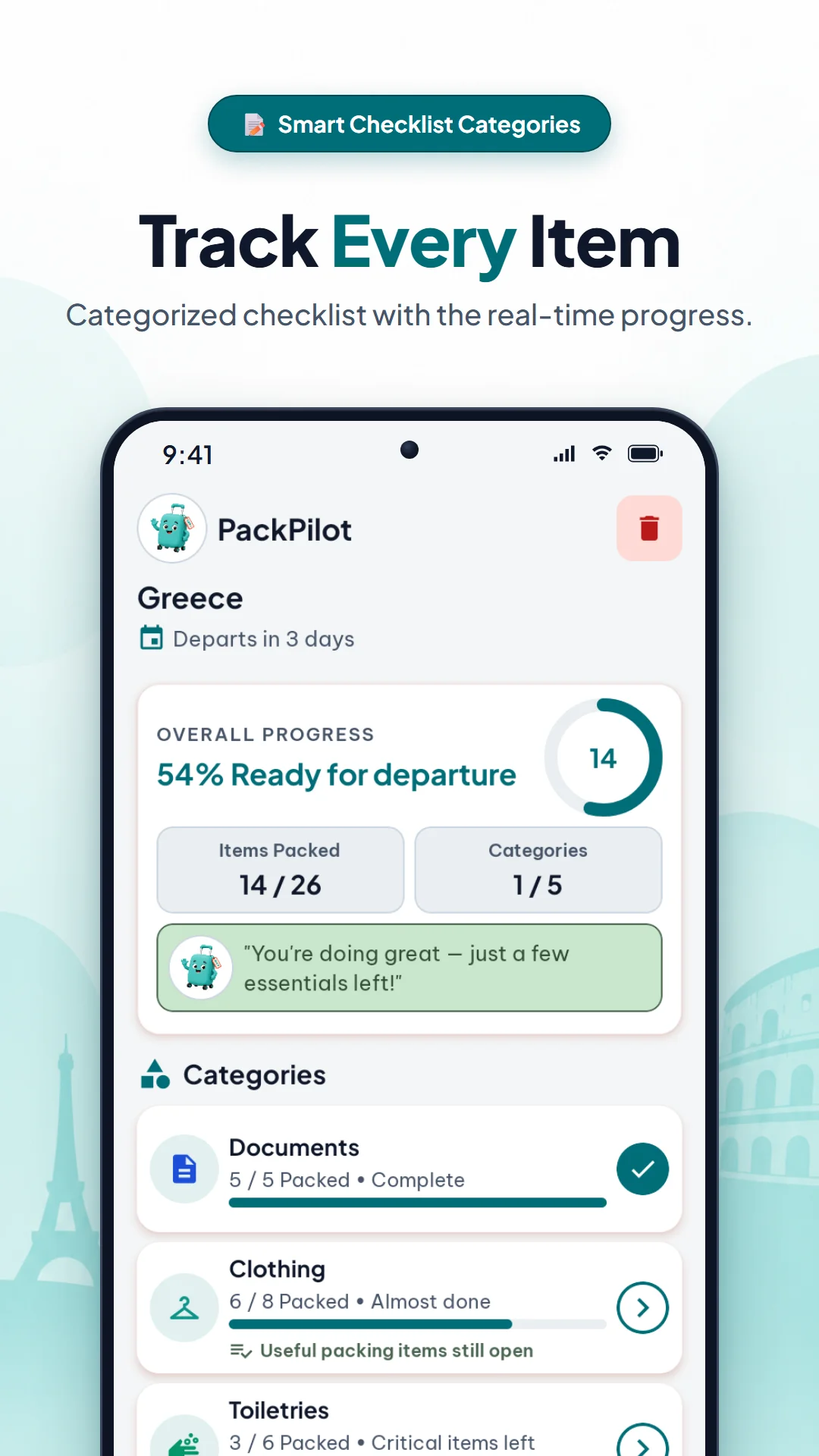
In PackPilot, set your trip length and Zippy calculates recommended quantities automatically. A longer trip means higher counts, and laundry access brings them back down. Add activities — beach, hiking, business meetings — and the relevant items fold in without you rebuilding the list from scratch.
Choose the light (carry-on) packing style if you are travelling with a cabin bag only. Once saved, the list opens offline, on the plane and at your hotel.
Related Travel Guides
- How to Pack Light: The Ultimate Carry-On Only Travel Checklist
- The Ultimate Capsule Wardrobe for Travel: Pack for 2 Weeks in a Carry-On
- Business Trip Packing List: What to Pack for a 3-5 Day Work Trip
- Best Packing List Apps Compared: PackPoint vs Packr vs PackPilot
- Carry-On Size Limits by Airline: What Actually Gets Enforced
- Expert Travel Packing Guides & Checklists
- PackPilot AI Travel Checklist App
Frequently Asked Questions
Not seven. Around four tops, three bottoms, and one outer layer covers a week, because bottoms and outerwear are worn repeatedly while tops are not. That is roughly 5-4-3-2-1: five pairs of socks and underwear, four tops, three bottoms, two pairs of shoes, one jacket. Add one dressier outfit if your week includes an evening out.
Yes, comfortably, and this is the trip length where carry-on only is easiest to justify. A week needs barely more than a long weekend once you stop packing one outfit per day. The items that break a carry-on are shoes and bulky outerwear, not clothing volume, so limit yourself to two pairs of shoes and wear the heaviest layer in transit.
No. Seven days is the longest trip that comfortably needs no laundry at all, which is why it is a useful ceiling. For anything beyond about ten days, do a single wash around the halfway point rather than packing more — the bag size stops growing and the trip length stops mattering.
Two. Wear the bulkiest pair in transit and pack one alternative. Shoes are the heaviest and least compressible thing in any bag, and a third pair is almost never worn. If your week needs both hiking boots and dress shoes, that is the trip where you check a bag.
Less than a full liquids bag. Standard 100ml travel bottles hold far more than a week of normal use — most people return home with them still half full. Switching shampoo and conditioner to solid bars removes them from the liquids limit entirely and frees space for sun cream or contact lens solution.
Yes. Set your trip to seven days, add your destination and activities, and Zippy calculates quantities from the trip length rather than giving you a fixed list. Turn on laundry access and the clothing counts come down, so you are not mentally recalculating outfits each time you travel.